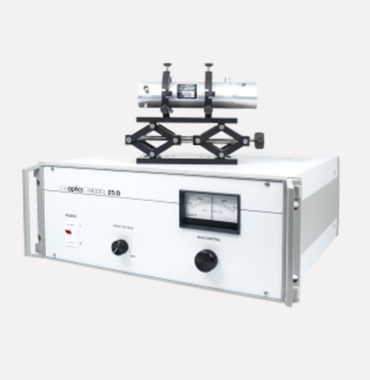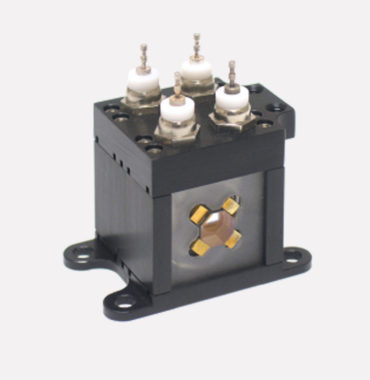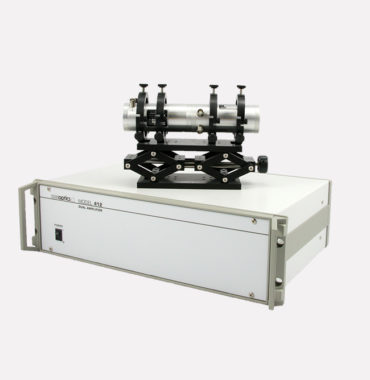
Conoptics series of electro-optic laser beam deflectors utilize a quadrapole electric field in an electro-optic material to produce a linear refractive index gradient proportional to the applied signal voltage. Choice of the proper material and crystallographic orientation eliminates piezoelectric ringing normally associated with other deflectors. There are no moving parts and they do not fatigue with prolonged use.
Free Product Whitepapers
Download Now!
Specifications
The angular deflection of E-O Deflectors is small but has rapid random access response and is extremely precise. Major applications include facet to facet error correction in laser data and image recorders which use spinning mirrors and the generation and stabilization of auxiliary tracks in optical disk mastering machines. Unlike acousto-optic deflectors, the intrinsic random access response of an electro-optic deflector is the optical rather than acoustic transit time. In practice, however, E-O Deflectors appear as capacitive loads and the response is driver limited. The precision with which a laser beam can be located, for all intents and purposes, is equivalent to the precision with which a voltage level can be applied to the device. Since operation is based on an index gradient, variations due to ambient temperature changes are reduced to second order effects. Similarly, unlike acousto-optic deflectors in which the deflection angle is proportional to the optical wavelength, the deflection angle of an electo-optic deflector is a function of the index dispersion and is relatively constant over the wavelength range of operation.
Other advantages of an E-O Deflector over an acousto-optic device include the fact that the entire beam is deflected. The transmission efficiency is limited only by the Fresnel reflections, absorption, and scattering losses in the cell and is not a function of the deflection mechanism.
Furthermore, E-O Deflectors are "straight through" devices, that is, the beam is deflected about the un-deflected zero applied signal position. This is in contrast to acousto-optic devices which have a large angular offset to the center of the deflection range and require that RF be maintained on the cell when the beam is in the quiescent position.
The
deflection angle,
of
an E-O Deflector is given by:
Where K is a constant determined by the electro-optic material used, V is the applied voltage, L is the active length of
the device, and a is the departure diameter. Translating deflection
angle to the number of resolvable spots:
Where
a diffraction limited Gaussian beam of a diameter and wavelength
is assumed and beam clipping losses are ignored.
Since V/a is limited by the internal breakdown
voltage (approx.1000v/mm for fluid filled units), once an electro-optic
material and operating wavelength have been chosen, the active
length is the only parameter remaining to increase the number
of resolvable spots. Note that the equation given above is highly
idealized and that "V" and "a" deserve considerable
consideration because they determine the difficulty of electronics
design and crystal fabrication.
Conoptics offers several standard electronics drivers which may be
use with our
E-O Deflectors. The Model 301 allows switching with an 80 nanosec. access time between
any two preselected levels within the range of ± 200 volts
of zero. The Model 302 is a DC coupled analog driver and has random
access time of 2.5 microsec. over a range of ± 400 volts. Many
operational requirements, however, are more easily satisfied by modifications
and special versions of the 310A and drivers. The most common changes
are larger aperture diameters, operation in the UV and IR, and higher
output voltage drivers with special waveforms. Construction of X-Y
systems by coupling two deflectors with an intermediate polarization
rotator is also common. Addition of a sensor and feedback loop driver
allows the construction of a beam pointing stabilizer.
Deflection
System
Model 308 High Voltage Digital Driver + Model 302
with Model 312-5 Five Crystal Deflector
Four Crystals for Digital; One for Analog
Digital
1)
Deflection
+/-
1.5 milliradians (symmetric)
2)
Rise/Fall
Times
<60
nsec
3)
Maximum
Pulse Width
<100
microsec
4)
Cable
length Driver/Deflector
<40
cm
5)
Rep
Rate
<1
kHz
6)
No
DC Centering
7)
Droop
<< 5%
8)
Amplitude
Control
Internal
0 to 1 Kv
Analog
1)
Deflection
+/-
0.3 milliradians
2)
Bandwidth
DC
to 250 kHz
3)
DC
Centering
<+/-
90 microradians
4)
Driver
Model
302 (See Data Sheet)
Model
317 Dual Deflection System
System
Consists of a model 311A
"Partitioned" Deflector and 2 Drivers
<0
dbm (626mv P-P) signal must have net
DC
= zero waveform (50% duty cycle)
5)
Dimensions
122
x 38.1 x 49.9 cm
6)
Maximum
Pulse Width (2% droop)
200
nsec
7)
Static
DC Bias Range
0
to 550v
8)
Electrical
Input Power
1.6
KW
Model
302 Driver
1)
Connected
to Single Crystal Port
0
to +/- 0.3 mrad;DC to 200 Khz
2)
Access
Time
<1
microsecond
3)
Input
Requirement
<2
Volts P-P
4)
Input
Impedance
<50
Ohms
5)
Output
Voltage
750
Volts P-P
6)
-3
db Bandwidth
200
Khz
7)
Driver
Cabinet
6.5"
W x 4.125" L x 4..15" H
8)
Power
Suply Cabinet
19"
Rack x 5.25" H
Model 301
The
system consists of a special version of the Model 311A Beam Deflector
and a dual driver. This has been used for generation of auxiliary tracks
in optical mastering equipment. The system accepts two inputs to generate
analog and digital deflection.