
Domestic: (800) 748-3349 – International: (203) 743-3349
If you have ever watched a two-photon image flicker frame to frame even though nothing in the sample moved, you already know the culprit is rarely the biology. It is the laser. Amplitude noise that would barely register in a linear imaging modality becomes a visible, sometimes data-ruining problem once the signal depends on intensity raised to a power.
We spend a lot of time with researchers who are chasing weak fluorescence signals deep in scattering tissue, often during long in vivo sessions where the specimen cannot be repositioned or re-run. In that setting, laser stability is not a nice-to-have. It is the difference between a usable dataset and a session that has to be repeated. What would a 1-2% reduction in shot-to-shot power fluctuation actually be worth to your longest imaging protocols?
This article looks at what a laser noise eater does, why nonlinear microscopy is particularly sensitive to intensity noise, and how active feedback stabilization compares to simpler passive approaches.
What a Laser Noise Eater Actually Does
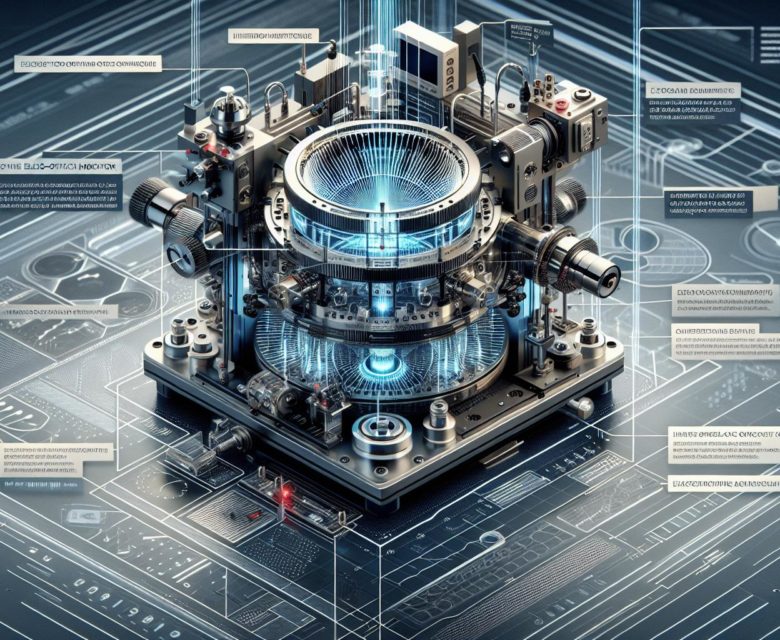
A laser noise eater is an active feedback device that measures a laser beam’s intensity in real time and corrects deviations before they reach the sample. The core components are simple: a fast photodiode samples a small pick-off of the beam, an electronic control loop compares that reading to a reference set point, and an electro-optic modulator (EOM) — often a Pockels cell — adjusts the transmitted power accordingly. Because the correction element is electro-optic rather than mechanical, the response time is limited by electronics and crystal properties, not by moving parts, so correction bandwidths from the kilohertz range up into the megahertz range are achievable depending on the design.
This is fundamentally different from a laser that is simply “quiet” by design. Even well-engineered laser sources drift with pump diode aging, thermal cycling in the gain medium, mechanical vibration, and mode competition. A noise eater does not prevent these disturbances at their source; it measures the result and cancels it downstream, in the same way active noise-cancelling headphones do not silence the room but subtract the sound before it reaches your ear.
Why Nonlinear Microscopy Is Especially Sensitive
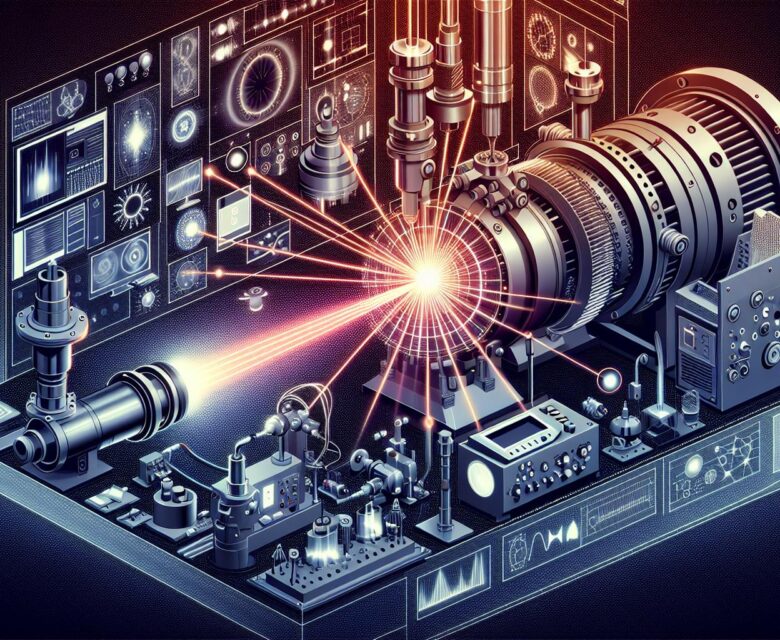
In two-photon excitation, fluorescence emission scales approximately with the square of the incident intensity. In three-photon imaging, it scales with the cube. This nonlinearity is exactly why multi-photon microscopy gives such good optical sectioning — but it also means that intensity noise on the excitation beam does not pass through to the image linearly. A 2% intensity fluctuation becomes roughly a 4% fluctuation in two-photon signal, and closer to 6% in three-photon signal.
That amplification compounds over an imaging session. Frame-to-frame brightness variation shows up as flicker in time-lapse data. Slow drift over minutes shows up as apparent photobleaching that is really just declining excitation power, confounding any quantitative comparison between the start and end of a recording. In ratiometric or quantitative fluorescence measurements — calcium imaging, FRET, intensity-based biosensors — this noise translates directly into measurement error that can be mistaken for a biological signal.
Improving Signal-to-Noise Without Raising Average Power
The most direct benefit of active stabilization is a cleaner signal-to-noise ratio (SNR) at a given average power. Because shot noise and detector noise are largely fixed by photon statistics and electronics, any excess variance coming from the laser itself is pure overhead — noise that adds to the measurement without adding information. Removing it tightens the distribution of pixel intensities around their true value, which matters most for the dim voxels deep in tissue where signal is already scarce.
This has a second, less obvious payoff. Once excess laser noise is no longer masking real signal, researchers often find they can reduce average excitation power and still resolve the features they need. Lower average power at the same effective SNR means less two-photon absorption in the focal volume, which is the dominant mechanism behind photobleaching and phototoxicity in live-tissue imaging. For chronic in vivo preparations — cranial window imaging repeated over days or weeks in the same animal — that reduction in cumulative photodamage can be what makes a longitudinal study viable at all.
Passive Stabilization vs. Active Feedback
Passive approaches — beam-splitting attenuators, fixed neutral density filters, or simply operating a laser well within its rated power range — reduce peak-to-peak variation somewhat but cannot respond to noise that changes over time. They set a ceiling; they do not track a moving target.
Active feedback stabilization is fundamentally a control loop, and its performance is defined by two things: how fast it can sense a deviation and how fast the correction element can act on it. A photodiode responds essentially instantaneously; the limiting factor is almost always the modulator and its driver electronics. This is where the choice of correction element matters. A Pockels cell driven by a fast, low-noise high-voltage amplifier can correct disturbances well beyond the mechanical resonances that limit acousto-optic or mechanical attenuators, which makes it well suited to the broadband, often unpredictable noise spectrum of mode-locked laser sources used in multi-photon systems.
Bandwidth and Response Time in Practice
Not every noise source needs megahertz correction bandwidth. Slow thermal drift over minutes can be handled by a modest control loop. Pump-noise-driven fluctuations in the kilohertz-to-megahertz range, however, require a feedback loop with enough bandwidth to actually track the disturbance rather than lag behind it — a loop that is too slow will under-correct fast noise and can even add ripple of its own if not properly damped. Matching loop bandwidth, EOM response, and photodiode sensitivity to the actual noise spectrum of the source laser is where the engineering judgment comes in, and it is different for a fiber laser, a Ti:Sapphire oscillator, and an amplified system.
Stabilizing Long Imaging Sessions
In vivo two-photon imaging sessions can run for hours, spanning long-term potentiation protocols, awake-behaving recordings, or repeated volumetric scans across a chronic window. Over that timescale, even a laser with excellent short-term stability will drift as thermal equilibrium shifts and components age within a work session. An active noise eater holds the delivered power at the sample close to a fixed reference throughout, which keeps early and late frames in a session quantitatively comparable — a prerequisite for any analysis that treats intensity as data rather than just a picture.
Working With Our Team
Every laser source has its own noise signature, and every microscope has its own tolerance for it depending on the measurement being made. If you are seeing session-to-session variability that does not track with your biology, or you are trying to lower excitation power without losing signal, we are glad to talk through the specifics of your setup. Our engineers work with multi-photon imaging groups regularly and can help match a noise eater’s feedback bandwidth and Pockels cell configuration to your particular laser and imaging protocol — reach out to discuss your application.