

Domestic: (800) 748-3349 – International: (203) 743-3349
Have you ever wondered how your internet connection zips data across vast distances at lightning speed? The secret lies in a tiny but mighty device called an optical modulator. It’s like a super-fast traffic light for light signals, controlling the flow of information through fiber optic cables.
Optical modulators come in different flavors, each with its unique way of manipulating light. Electro-optic modulators, for instance, use an electric field to change the refractive index of a material, thereby modulating the light passing through it. An electro optic amplitude modulator specifically controls the amplitude of the optical beam, allowing precise adjustments to the light’s intensity and phase. This functionality is crucial in laser systems and other applications where controlling the optical beam parameters is essential.
Optical modulators are a foundational building block in fiber-optic communication and laser systems because they provide a controlled, repeatable way to translate electrical information into changes in a light wave. In real deployments, performance is defined not only by a device’s modulation method, but also by practical engineering constraints like insertion loss, drive voltage, impedance matching, thermal stability, and how cleanly the modulator interfaces with lasers, detectors, and fiber coupling optics. This article focuses on the concepts a reader needs to evaluate modulators in context: what property is being changed, what tradeoffs that creates, and what those tradeoffs mean for system-level reliability.
Introduction to Optical Modulators
Imagine you have a magical remote control that can change the way light behaves. That’s essentially what an optical modulator does! An optical modulator is a device that tweaks the properties of an optical beam—like its intensity, phase, or polarization—using an electrical signal. These nifty gadgets are the backbone of high-speed data transmission, laser technology, and even some scientific measurements.
Optical modulators come in different flavors, each with its own unique way of manipulating light. Electro-optic modulators, for instance, use the electro-optic effect to change the refractive index of a material when an electric field is applied. It’s like having a dimmer switch for your lights, but way cooler. Then there are acousto-optic modulators, which use sound waves to create ripples in special crystals, modulating the optical beam as it passes through. Think of it like tossing a pebble into a pond and watching the ripples spread out. Lastly, magneto-optic modulators use magnetic fields to steer the light, much like a compass needle aligns with the Earth’s magnetic field.
These modulators can achieve various modulation formats. Amplitude modulation is like adjusting the brightness of a lamp, while phase modulation is akin to tweaking the timing of a wave. Polarization modulation, on the other hand, changes the orientation of the light wave, similar to rotating a pencil between your fingers.
Beyond their role in optical communication systems, where they convert electrical signals into optical signals for lightning-fast data transmission, optical modulators are also key players in laser technology. They control the intensity, frequency, and duration of laser beams, making them indispensable in everything from medical procedures to cutting-edge manufacturing. In spectroscopy, they help scientists measure changes in optical signals, providing valuable insights into the properties of materials.
In this article, we’ll dive deeper into the different types of optical modulators, explore how they work, and look at their various applications. We’ll also discuss their advantages and limitations and take a peek into the future of this fascinating technology. So, buckle up and get ready for a journey into the world of optical modulators!
In product selection and system design, engineers typically start with the modulation requirement and work backward: the operating wavelength, bandwidth target, acceptable drive voltage, and optical power handling determine which modulator type is viable. From there, integration details often decide the final choice, including packaging, connectorization, fiber pigtailing options, bias control needs, environmental sensitivity, and the available driver electronics. This is why two modulators that look similar in a catalog can behave very differently once installed in a real optical path. The most reliable outcomes come from matching the device’s measured operating behavior to the specific system environment rather than relying on a single headline specification.
Optical Isolators for Lasers
Key Takeaways
An optical modulator is like a light switch for fiber optic networks. It controls the flow of light signals, turning them on and off at lightning-fast speeds. Imagine you’re playing a game of flashlight tag, but instead of using your finger to block the light, you’re using a super-fast shutter. That’s essentially what an optical modulator does in the world of telecommunications.
Ever wondered how your cat videos travel across the internet so quickly? The secret lies in these nifty devices. Optical modulators take the digital information from your computer and encode it onto light waves. They’re the unsung heroes of our connected world, working tirelessly behind the scenes to keep our data flowing smoothly.
But how do they actually work? Picture a prism splitting white light into a rainbow. An optical modulator does something similar, but instead of separating colors, it manipulates light waves to carry information. It’s like teaching light to speak in binary code – pretty cool, right?
Here’s a fun fact: optical modulators can switch light on and off billions of times per second. That’s faster than you can say “supercalifragilisticexpialidocious” – even if you’re Mary Poppins! This incredible speed is what allows us to stream our favorite shows without buffering or sending emails in the blink of an eye.
We’ve come a long way from smoke signals and carrier pigeons. Today’s optical modulators are the result of decades of scientific research and engineering innovation. They’re constantly evolving, getting faster and more efficient with each passing year. Who knows what the future holds for these tiny but mighty devices?
Types of Optical Modulators
Optical modulators come in various types, each designed to manipulate light signals in unique ways. We’ll explore three main categories: electro-optic modulators, acousto-optic modulators, and magneto-optic modulators.
Electro-Optic Modulators
Electro-optic modulators (also called EO Modulators) use electric fields to change the properties of light. They’re like dimmer switches for fiber optics, controlling light intensity with electrical signals. EO modulators rely on materials that alter their refractive index when exposed to an electric field. This phenomenon is known as the linear electro optic effect, where the refractive index change is directly proportional to the applied electric field. This change in refractive index modifies how light travels through the material. An amplitude modulator, a type of electro-optic modulator, specifically controls the amplitude of optical beams through the application of an external electric field. This allows us to encode information into the light beam. Electro optic modulators are used in various systems for controlling the amplitude, phase, and polarization of optical beams.
Acousto-Optic Modulators
Acousto-optic modulators use sound waves to manipulate light. Imagine a pond with ripples – that’s similar to how these modulators work. They create sound waves in special crystals, which act like moving gratings. As light passes through these “ripples,” it’s diffracted and modulated. This process allows us to control the frequency, intensity, and direction of light beams with great precision.
Magneto-Optic Modulators
Magneto-optic modulators harness magnetic fields to influence light. They’re like tiny light compasses, steering photons with magnetism. These devices use materials that change their optical properties in response to magnetic fields. By applying a magnetic field, we can rotate the polarization of light or alter its phase, effectively encoding information into the light signal.
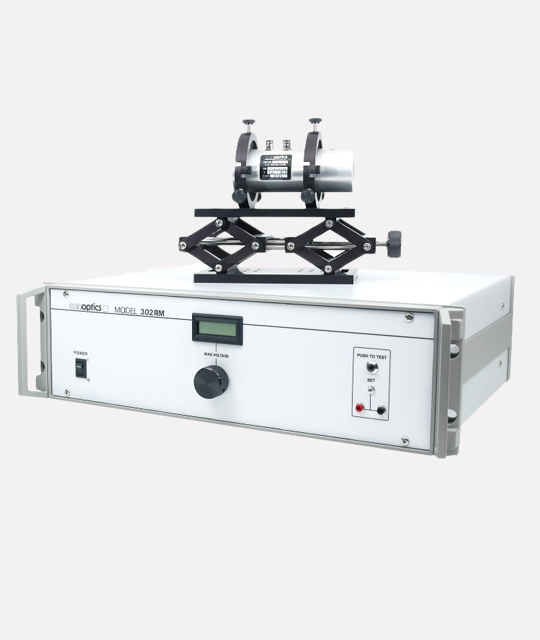
Laser Modulation Systems
Conoptics is delivering products in 30 to 60 days. Call now to place your order.
Domestic (800) 748-3349 – International (203) 743-3349
Laser Modulator Systems by Conoptics
How Optical Modulators Work
Optical modulators manipulate light waves to encode information. These devices use various techniques to control and modify the properties of light, enabling high-speed data transmission in optical networks.
Basic Principles
Optical modulators operate by altering the characteristics of light waves. They change the amplitude, phase, or polarization of light to encode data. These modulators control the optical beam electrically to achieve precise modulation, allowing for the manipulation of light properties without degrading the laser’s performance. Think of it like adjusting the volume on your radio – the modulator “turns up” or “turns down” specific aspects of the light wave.
We often compare optical modulators to tiny traffic controllers for photons. They direct these light particles, telling them when to go, stop, or change direction. This process happens at mind-boggling speeds, with modulators switching billions of times per second.
Ever wondered how your cat videos travel across the internet so quickly? It’s these little light switches doing the heavy lifting!
A helpful way to think about modulator performance is to separate the physics from the implementation. The physics describes what property of the light is being changed, while the implementation determines how cleanly and consistently that change occurs when the device is installed, cabled, and driven at speed. Real-world performance is often limited by integration factors such as parasitic capacitance and inductance, RF reflections, connector losses, and bias point stability over time. Validating a design typically involves both characterization measurements and system-level tests so that the modulator’s behavior under operating conditions matches the application’s tolerance for noise, drift, and nonlinearity.
Modulation Techniques
Optical modulators use several techniques to encode data into light waves:
- Amplitude modulation: This method varies the intensity of light, like dimming a lamp. Direct modulation, which controls the input current of semiconductor lasers, is one approach but has limitations such as frequency shifts and reduced laser life, making external modulators a more stable alternative.
- Phase modulation: It changes the timing of light waves, similar to adjusting your watch.
- Polarization modulation: This technique alters the orientation of light waves, like rotating a pencil.
A study published in Nature Photonics compared the performance of amplitude, phase, and polarization modulators in 400G optical networks. The research found that hybrid modulation schemes—especially combining phase and amplitude modulation—offered the best balance of data throughput and signal integrity over long distances. This finding has influenced design strategies for transceivers in subsea cables and intercontinental data routes.
Each technique has its strengths, and engineers often combine them for optimal performance. It’s like mixing ingredients in a recipe – the right combination creates the perfect dish, or in this case, the most efficient data transmission.
Applications of Optical Modulators
Optical modulators are versatile devices with widespread applications across various industries. Let’s explore how these light-manipulating tools are used in different fields.
Optical modulators show up across industries because they provide a controllable interface between electronics and photonics. In communications, they support dense, high-speed links where preserving signal quality over distance is critical. In lasers and instrumentation, they enable repeatable control of optical power and timing that is difficult to achieve through direct laser modulation alone. Across these use cases, the practical differentiator is often not whether a modulator can modulate, but whether it can maintain the required performance over time, across temperature variation, and under the exact operating bandwidth and optical power conditions of the system.
Telecommunications
Optical modulators are the backbone of modern telecommunications networks. They encode data onto light signals, enabling high-speed internet and long-distance communication. In fiber optic networks, these devices convert electrical signals into optical signals, allowing for faster and more efficient data transmission. Think of them as translators, turning our emails, videos, and voice calls into light pulses that zip through fiber optic cables at incredible speeds.
Optical Computing
In the realm of optical computing, modulators play a crucial role in processing information using light instead of electricity. They act as switches and logic gates, similar to transistors in traditional computers. By manipulating light waves, optical modulators can perform complex calculations at the speed of light. Imagine a computer that uses beams of light to crunch numbers – that’s the potential of optical computing!
Laser Technology
Laser technology benefits greatly from optical modulators. These devices control laser beams’ intensity, frequency, and duration. By manipulating these properties, optical modulators play a crucial role in optical signal processing and communication technologies. From precise medical procedures to cutting-edge manufacturing techniques, modulators fine-tune laser beams for optimal performance. The ability to control and manipulate optical power is essential in laser technology, making them invaluable in various applications. It’s like having a dimmer switch for lasers, allowing us to adjust their power and precision for different tasks. Phase modulated optical beams are particularly important in applications like laser stabilization and mode-locking, where precise control over the phase of the optical beam is required.
In advanced manufacturing settings, optical modulators are used to precisely control laser pulses for micromachining and 3D printing. For example, in femtosecond laser processing—a technique used to create intricate structures on glass or metal surfaces—modulators regulate the intensity and duration of laser bursts down to the picosecond. This level of control allows for non-contact cutting and engraving with exceptional precision, reducing waste and minimizing thermal damage to materials.
Leading researchers in photonics emphasize the growing role of modulators in shaping the next generation of communication systems. According to a 2023 report from the IEEE Photonics Society, advancements in electro-optic materials are paving the way for faster and more energy-efficient modulators. These improvements are vital for scaling 5G infrastructure and preparing for the demands of 6G. As global data usage continues to skyrocket, the ability to precisely control light at ultra-fast speeds will be key to ensuring reliable, high-bandwidth connectivity.
Advantages and Limitations
When evaluating advantages and limitations, it helps to frame them the way system designers do: what performance goal is driving the choice, and what constraints come with it. High bandwidth, low distortion, and stable operation often require careful RF design, controlled biasing, and thermal management. Cost and size are sometimes secondary to reliability in long-lived telecom links and precision measurement systems, while compactness and power efficiency may dominate in integrated photonics and short-reach interconnects. Presenting the tradeoffs in this system-level way builds trust because it reflects how modulators are actually selected and qualified in practice.
Optical modulators are like the unsung heroes of our digital world. They’re the workhorses that keep our data flowing at lightning speeds. But like any technology, they come with their own set of pros and cons. Let’s dive in and explore these together, shall we?
Advantages
Optical modulators are speed demons. They can switch light on and off billions of times per second, making our internet connections faster than a cheetah on roller skates. Imagine trying to blink that fast – you’d probably sprain an eyelid!
These devices are energy-efficient too. They use less power than traditional electronic systems, which means they’re not just fast, but also eco-friendly. It’s like having a sports car that runs on air!
Optical modulators are also incredibly versatile. They can work with different types of light and data formats, adapting to various situations like a chameleon changes colors. This flexibility makes them perfect for a wide range of applications, from telecommunications to medical imaging.
Limitations
But it’s not all sunshine and rainbows in the world of optical modulators. One of their biggest challenges is their sensitivity to temperature changes. They can be as moody as a cat in a bathtub when the temperature fluctuates. This sensitivity complicates efforts to obtain linear amplitude modulation, as maintaining the necessary bias point requires precise control and various methods to counteract temperature effects.
“During our experiments with electro-optic modulators in ultrafast laser systems, we noticed that even minor shifts in ambient temperature could affect the bias point significantly. We had to integrate active thermal control systems to maintain consistent performance,” said Dr. Maya Han, Optical Engineering Researcher at MIT Media Lab.
Another hurdle is the cost. High-quality optical modulators can be pricey, making them less accessible for some applications. It’s like wanting a gourmet meal but having a fast-food budget.
Size is also a consideration. While they’re getting smaller, some optical modulators are still too big for certain compact devices. Imagine trying to fit a watermelon in your pocket – that’s the challenge engineers face when integrating these components into smaller gadgets.
Have you ever wondered how these advantages and limitations affect our daily lives? From the speed of our internet connections to the development of new technologies, optical modulators play a crucial role. They’re the unsung heroes working behind the scenes to keep our digital world spinning.
Future Developments in Optical Modulation
Current development trends in optical modulation are largely centered on integration, lower drive voltage, and improved energy efficiency, especially for data-center and high-density photonics environments. As modulators move toward tighter integration with photonic circuits, packaging and thermal behavior become as important as the device physics, because small shifts in temperature or bias can have outsized effects on signal quality at high speeds. The most meaningful advances tend to combine better materials with better integration methods, so the modulator’s performance remains stable not just in a lab demonstration, but in continuous operation inside real systems.
As we peer into the crystal ball of optical modulation technology, we can’t help but feel excited about what’s on the horizon. Remember when dial-up internet made that unforgettable screeching sound? Well, future optical modulators might make our current tech seem just as outdated!
Miniaturization and Integration
Optical modulators are shrinking faster than your favorite pair of jeans in the dryer. We’re talking about devices so small they could fit on the head of a pin! This miniaturization trend opens up a world of possibilities for integrating optical modulators into everyday devices. Imagine your smartphone with built-in optical modulation capabilities. How cool would that be?
Recent innovations in materials science have led to the development of novel electro-optic crystals such as lithium niobate on insulator (LNOI) and barium titanate. These materials offer superior bandwidth and lower voltage requirements, making them ideal for compact modulator design. Unlike traditional bulk crystals, these thin-film platforms enable integration with silicon photonics, opening the door to on-chip modulators that can be mass-produced for commercial applications.
Increased Bandwidth and Speed
Hold onto your hats, folks, because optical modulators are about to get even faster. We’re looking at speeds that could make The Flash look like he’s running in slow motion. These advancements will allow for lightning-quick data transmission, making buffering a thing of the past. Who’s ready to say goodbye to the spinning wheel of doom?
Energy Efficiency
Future optical modulators will be greener than a salad bar. Engineers are working tirelessly to reduce power consumption while maintaining high performance. This eco-friendly approach not only helps the planet but also means longer battery life for our devices. It’s a win-win situation that’ll have Mother Nature giving us a high-five!
Novel Materials
Scientists are cooking up new materials for optical modulators like chefs experimenting with exotic ingredients. These novel materials could revolutionize how we manipulate light, leading to more efficient and versatile modulators. What if we could control light as easily as changing TV channels with a remote?
Quantum Optical Modulation
Buckle up, because we’re diving into the weird and wonderful world of quantum mechanics! Quantum optical modulation is like teaching light to do backflips while juggling. This cutting-edge technology could lead to ultra-secure communication systems and super-fast quantum computers. Are you ready to join the quantum revolution?
According to Allied Market Research, the global optical modulator market is projected to exceed $55 billion by 2030, driven by the expansion of cloud computing, video streaming, and quantum communication. The need for faster, smaller, and more efficient modulators is prompting investments in R&D across telecom giants and photonics startups alike. As data center operators push the limits of bandwidth, optical modulators remain at the heart of next-gen infrastructure.
Conclusion
Optical modulators are the unsung heroes powering our digital world. These remarkable devices enable lightning-fast data transmission and open doors to exciting technological advancements. As we’ve explored their types applications advantages and future potential we can appreciate their crucial role in shaping our connected lives. From enhancing telecommunications to revolutionizing quantum computing optical modulators continue to push the boundaries of what’s possible. We’re excited to witness the ongoing evolution of these innovative devices and their impact on our increasingly digital future.
If you have any questions or would like to learn more about how optical modulators can benefit your projects, feel free to contact us. Our team is here to help!
Frequently Asked Questions
What is an optical modulator?
An optical modulator is a device that controls the flow of light in fiber optic cables, enabling high-speed internet connections. It functions like a traffic light for light signals, encoding digital information onto light waves for rapid data transmission. Optical modulators can switch light on and off billions of times per second, making them crucial for seamless streaming and instant communication.
How do optical modulators work?
Optical modulators work by altering the characteristics of light, such as its amplitude, phase, or polarization. They use various methods, including electro-optic, acoustic-optic, and magneto-optic effects, to manipulate light waves. These methods impact the optical signal by modulating it, which affects transmission speed, phase delay, and integration within optical communication systems. These devices can switch light on and off rapidly, encoding digital information onto the light signal for transmission through fiber optic cables.
What are the main types of optical modulators?
The three main types of optical modulators are:
- Electro-optic modulators: Use electric fields to change light properties
- Acousto-optic modulators: Use sound waves to alter light
- Magneto-optic modulators: Use magnetic fields to manipulate light
Each type utilizes different physical principles to achieve modulation, offering various advantages depending on the application.
What are the applications of optical modulators?
Optical modulators have widespread applications in telecommunications, optical computing, and laser technology. They are essential for enhancing data transmission in fiber optic networks, and enabling high-speed internet and communication systems. In optical computing, they help process information using light. Laser technology uses modulators for various purposes, including precise control of laser beams in scientific and industrial applications.
What are the advantages of optical modulators?
The main advantages of optical modulators include:
- High switching speeds, allowing for rapid data transmission
- Energy efficiency compared to electronic alternatives
- Versatility in handling different light and data formats
- Ability to enhance bandwidth and reduce latency in communication systems These benefits make optical modulators crucial for modern telecommunications and data processing.
What are the limitations of optical modulators?
Despite their advantages, optical modulators face several limitations:
- Sensitivity to temperature changes, which can affect performance
- High costs, especially for advanced or specialized modulators
- Size constraints, though miniaturization efforts are ongoing
- Complexity in manufacturing and integration with other optical components These challenges are areas of ongoing research and development in the field.
How are optical modulators evolving?
Optical modulators are evolving through miniaturization, allowing integration into smaller devices like smartphones. Research focuses on increasing bandwidth and speed for faster data transmission. Energy-efficient designs are being developed to improve performance and reduce environmental impact. Novel materials are being explored to enhance light manipulation capabilities. Additionally, quantum optical modulation is emerging as a groundbreaking area for ultra-secure communication and quantum computing.