

Domestic: (800) 748-3349 – International: (203) 743-3349
Precision and reliability matter deeply in advanced photonics. We know how important it is to work with laser technology that delivers exact results, especially in areas like scientific research, semiconductor manufacturing, and data storage. Are you curious about how laser wavelengths can be shifted with remarkable efficiency, opening new doors for specialized applications?
Frequency-doubled laser systems are at the forefront of many cutting-edge processes. Whether you work in research, industry, or advanced product development, understanding how these systems function means staying ahead of the curve. Let’s explore the principles, components, and real-world value behind frequency-doubled lasers, and why their role continues to grow.
Expand Your Capabilities with Conoptics Frequency-Doubled Laser Solutions
Precision and efficiency in frequency doubling demand more than just the right crystal—they require a system engineered for stability, alignment, and high-speed modulation. At Conoptics, we provide advanced electro-optic modulators, isolators, and drive electronics designed to optimize frequency-doubled performance across applications in research, semiconductor processing, data storage, and more.
Looking to achieve cleaner outputs, higher efficiency, and reliable wavelength conversion in your projects? Contact us today to discover how Conoptics can help you design and integrate frequency-doubled laser systems that meet your exacting standards.
Key Takeaways
- Frequency-doubled laser systems enable access to new wavelengths, making advanced photonics applications possible in research and industry.
- Successful frequency doubling relies on precise alignment and thermal control of nonlinear crystals such as KTP and LBO.
- These systems support robust modulation speeds and stability, proving essential for spectroscopy, semiconductor processing, and data storage.
- Designing frequency-doubled laser systems demands careful component integration and power management to maximize output and protect crystal integrity.
- While high conversion efficiency can be sensitive to alignment and temperature, the benefits of versatility and compactness often outweigh the challenges.
Understanding Frequency Doubling in Lasers
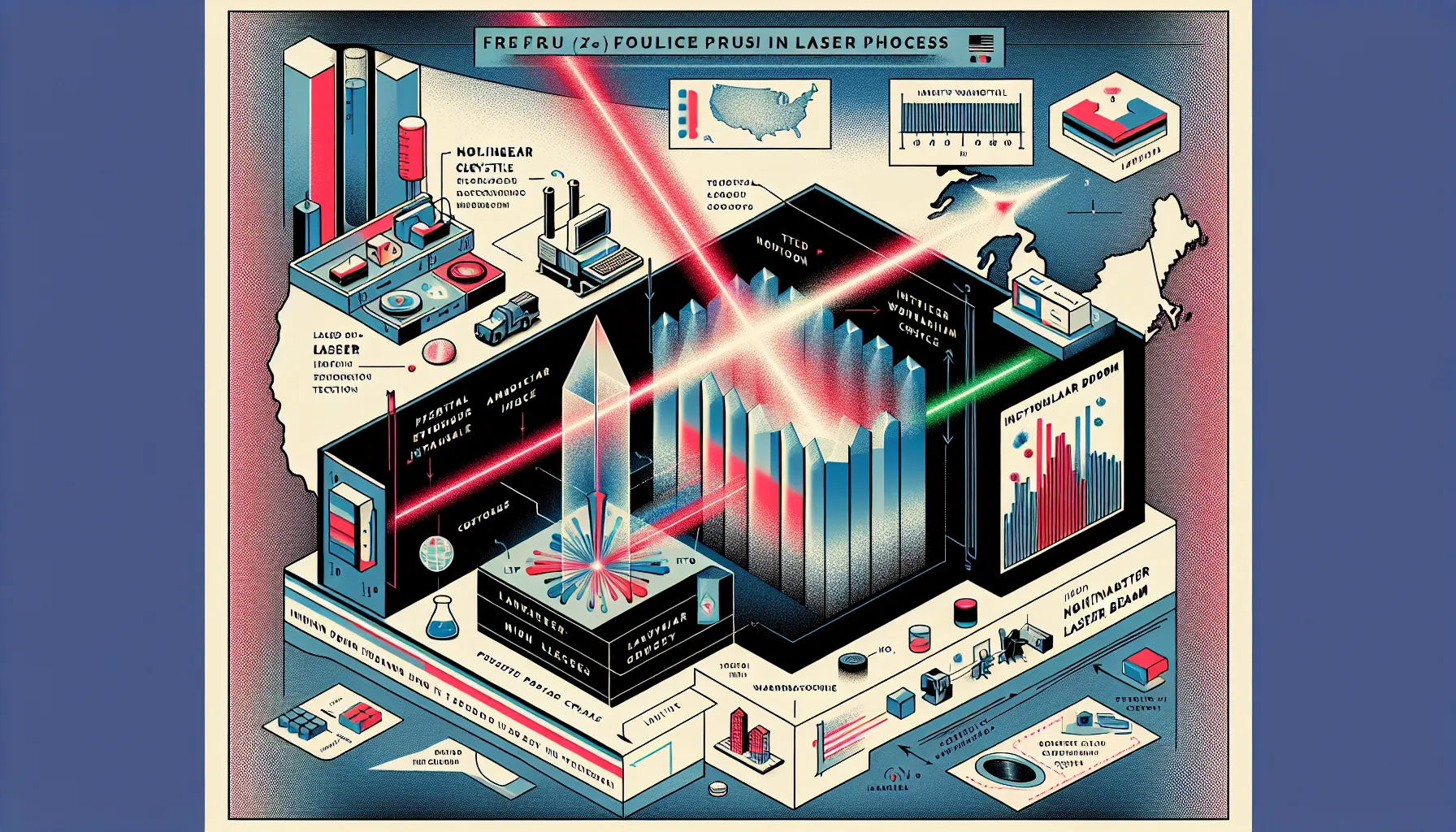
Frequency doubling, also called second harmonic generation (SHG), is a nonlinear optical process that converts photons at a fundamental laser frequency into photons at exactly twice that frequency. In simpler terms, this means we transform incoming laser light, say, at 1064 nm, into light at 532 nm. This shift allows access to wavelengths unavailable from conventional laser sources, filling a vital gap in photonic applications.
How does it work? When laser light passes through a nonlinear crystal (commonly potassium titanyl phosphate, KTP, or lithium triborate, LBO), the intense electromagnetic field interacts with the crystal lattice. This interaction encourages two photons from the original laser to combine their energies, releasing a new photon at twice the frequency and, hence, half the wavelength. It’s a clever trick that lets us generate visible light from infrared sources, or deeper ultraviolet from visible lasers.
The practical result: expanded spectral coverage across systems. Researchers rely on SHG to enable experiments that require specific wavelengths. In industrial processes, this technique lets us fine-tune laser outputs for everything from microfabrication to precision spectroscopy.
Core Components of Frequency-Doubled Laser Systems
Let’s break down what makes a frequency-doubled laser system work efficiently. A few key elements form the backbone of these setups:
Primary Laser Source
The process begins with a high-quality fundamental laser, often a pulsed or continuous-wave solid-state laser emitting at a wavelength such as 1064 nm (Nd:YAG or fiber lasers are common choices). The stability and beam quality here lay a foundation for successful frequency doubling.
Nonlinear Crystal
This component is at the heart of frequency doubling. Crystals like KTP, LBO, BBO, or periodically poled lithium niobate (PPLN) are chosen based on their transparency ranges and phase-matching characteristics. Accurate alignment of the crystal is essential.
Temperature and Phase Control
Even small fluctuations in temperature or angle can cause a drop in conversion efficiency. Many systems incorporate temperature stabilization and precise mountings to maintain ideal conditions within the nonlinear crystal.
Optical Coatings and Isolators
These minimize losses, manage stray reflections, and protect sensitive components from feedback that could disrupt system stability or induce noise.
Electro-Optic Modulators and Drive Electronics
Modulators play an important role in managing pulse timing, amplitude, and phase. Our product range, for example, supports bandwidths from 192 nm to 2000 nm and modulation up to 800 MHz. That means greater versatility across applications where control is key.
Beam Shaping and Delivery Optics
Lenses, mirrors, and fiber couplers ensure the frequency-doubled output goes precisely where it’s needed and matches required parameters such as beam profile and divergence.
Behind every efficient frequency-doubled system is careful integration of these components to maximize output while maintaining crystal integrity and beam quality.
Design Considerations for Frequency-Doubled Lasers
Crafting a high-performance frequency-doubled laser system involves several strategic decisions. We focus on balancing performance, reliability, and operational simplicity.
Crystal Selection and Phase Matching
Each nonlinear crystal material offers a different set of trade-offs, efficiency, damage threshold, and acceptance bandwidth. Selecting the appropriate material and aligning the crystal just right (sometimes called phase matching) dramatically increases frequency doubling effectiveness.
Power Management and Cooling
Higher power levels can boost output, but also raise risks of stray heating or photodamage within the crystal. Thermal control, including active temperature stabilization, becomes vital for consistent operation and preventing degradation.
Modulation Bandwidth
Modern systems often demand fast, precise control. Our experience includes developing electro-optic modulators and amplitude stabilizers that operate reliably up to the hundreds of megahertz. This level of control benefits pulse selection in mode-locked lasers or rapid switching in optical tweezers.
System Integration
It’s important to consider how the doubled output integrates with optical isolators, beam deflection modules, or fiber delivery systems. By designing with modularity in mind, we can easily adapt to evolving project requirements, whether for laboratory setups or semiconductor production lines.
Reliability and Customization
Application environments can be aggressive, think deep UV operation or high-repetition-rate disc mastering. That’s why precision engineering and attention to detail are paramount. We often provide custom solutions, ensuring that specialized projects receive equipment configured for their specific demands.
Applications of Frequency-Doubled Lasers
Where do frequency-doubled laser systems change the game? The answer spans laboratories, manufacturing floors, and development offices worldwide.
- Scientific Research: Frequency-doubled lasers are irreplaceable for experiments that call for specific visible or UV wavelengths. For example, in spectroscopy and fluorescence microscopy, shifting a laser’s output enables detection and analysis not possible with the original source.
- Semiconductor Processing: We supply systems supporting high-speed, high-extinction ratio modulation, essential for cutting-edge lithography and mask writing. Here, reliability and stability mean less downtime and higher yields.
- Data Storage and Disc Mastering: Lasers with frequencies doubled into the UV range are fundamental for mastering high-density optical discs. Our expertise with noise-eater modulators and multi-function deflectors removes unwanted fluctuations, supporting clean and clear data writes.
- Optical Tweezers and Trapping: Manipulating microscopic particles with light requires precise wavelengths and fast, flexible modulation. Frequency doubling delivers the necessary spectral options and the ability to finely adjust beam parameters.
- Laser Amplitude Stabilization: Consistent output power is essential. Frequency-doubled setups, coupled with state-of-the-art modulators, make it possible to sustain intensity stability in sensitive analytical techniques or industrial inspection systems.
- Color Separation and Imaging: In advanced printing and scanning, frequency-doubled lasers enable color separation systems, letting us break down high-resolution images or produce vivid output in color printers.
Every year, new uses for frequency-doubled lasers emerge, a testament to their adaptability and practical impact.
Advantages and Challenges of Frequency-Doubled Laser Systems
Frequency-doubled lasers bring distinct benefits, some of which make them the technology of choice for high-demand environments:
Advantages:
- Enables access to new wavelengths: By converting available laser sources into additional colors, we support applications from deep UV to visible and beyond.
- Improves versatility in research and manufacturing: Switching output wavelengths allows for quick adaptation to varying project needs, whether in scientific research or industrial processing.
- Supports high modulation speed and stability: With electro-optic control, we provide fast and precise pulse shaping for mode-locked lasers or amplitude stabilization, directly influencing results.
- Facilitates compact system design: Frequency doubling reduces the need for multiple laser sources, streamlining setups and saving space.
Challenges:
- Conversion efficiency is highly sensitive: Minor misalignments or temperature drift can diminish output, so ongoing monitoring and careful setup are required.
- Nonlinear crystals have operational limits: Each material has a burn-in threshold, so exceeding input power or environmental variability demands constant vigilance.
- Integration can be complex: Combining doubled lasers with modulators, beam deflectors, and isolators requires thorough understanding of laser physics, optics, and electronics.
Yet, for many users, these challenges are outweighed by the substantial gains in performance and operational flexibility. We consistently see our frequency-doubled systems delivering precise, reliable light for even the most challenging applications.
Conclusion
Frequency-doubled laser systems offer a smart, effective approach to expanding the utility and value of established laser sources. By harnessing nonlinear optical effects with well-engineered components, including advanced modulators, isolators, and drive electronics, we support researchers and industry professionals as their projects evolve.
If you’re looking for ways to achieve stable, high-performance output across a variety of wavelengths and modulation demands, frequency-doubling may be the key. We’re excited to see where new applications will take this technology next, and how we can help you bring your ideas to light.
Frequently Asked Questions About Frequency-Doubled Laser Systems
What is a frequency-doubled laser system?
A frequency-doubled laser system uses a process called second harmonic generation (SHG) to convert the fundamental wavelength of a laser into one with exactly twice the frequency. This allows the output light to have a different, often visible or UV, wavelength from the original infrared source.
How does frequency doubling work in lasers?
Frequency doubling works when laser light passes through a nonlinear crystal, such as KTP or LBO. The strong electromagnetic field encourages two photons from the original laser to combine, releasing a new photon at twice the frequency and half the original wavelength.
What are the main components of a frequency-doubled laser system?
Key components include the primary laser source (like Nd:YAG), a nonlinear crystal for frequency conversion, temperature and phase control systems, optical coatings and isolators, electro-optic modulators, and beam shaping or delivery optics to maximize output and ensure beam quality.
What are the primary applications for frequency-doubled laser systems?
Frequency-doubled lasers are used in scientific research, semiconductor processing, data storage and disc mastering, optical tweezers, amplitude stabilization, and advanced color separation and imaging tasks due to their ability to provide precise and stable output at desired wavelengths.
What are the advantages and challenges of frequency-doubled lasers?
Advantages include access to new wavelengths, system versatility, high-speed modulation, and more compact setups. Challenges involve the sensitivity of conversion efficiency to alignment and temperature, the operational limits of nonlinear crystals, and the complexity of integrating all system components effectively.
Can frequency-doubled laser systems be customized for specific applications?
Yes, frequency-doubled laser systems are often tailored to meet unique requirements. Customization can involve selecting the best nonlinear crystal, optimizing modulation bandwidth, or integrating additional optics to suit specialized research or industrial environments.