

Domestic: (800) 748-3349 – International: (203) 743-3349
Have you ever wondered how light can be manipulated and controlled with such precision that it transforms the way we conduct research or develop new technologies? At the very core of this ability are nonlinear optical crystals, a cornerstone in laser science and photonics. Many of us working in optics face tight requirements for bandwidth, purity, and stability. We understand the pressure to keep pace with scientific advances while maintaining reliability in every experiment or device. So, what allows a material to interact with intense beams of light in ways that seem almost magical? Let’s explore what nonlinear optical crystals can do, how their properties shape diverse solutions, and where their future might lead.
Advance Your Research with Conoptics Nonlinear Optical Solutions
Nonlinear optical crystals are the backbone of modern photonics, enabling frequency conversion, phase control, and precision modulation across demanding applications. At Conoptics, we provide advanced optical components engineered for performance, stability, and reliability—supporting industries from scientific research and telecommunications to semiconductor manufacturing and data storage.
Ready to integrate nonlinear crystal technology into your systems with confidence? Contact us today to learn how Conoptics can deliver solutions that meet your exact requirements.
Key Takeaways
- Nonlinear optical crystals are vital for advanced laser science and photonics, enabling unique manipulation of light frequencies and intensities.
- Essential properties like transparency range, high nonlinear coefficients, phase matching, and damage thresholds determine the performance of nonlinear optical crystals.
- Different nonlinear crystals such as BBO, KTP, and lithium niobate each offer specialized advantages for frequency conversion, optical modulation, and wavelength control.
- Applications of nonlinear optical crystals include pulse selection, laser amplitude stabilization, disc mastering, and precise optical tweezers, driving innovation in research and manufacturing.
- Ongoing research focuses on boosting the efficiency, thermal stability, and miniaturization of nonlinear optical crystals to meet the future demands of optical technology and communication.
Understanding Nonlinear Optics
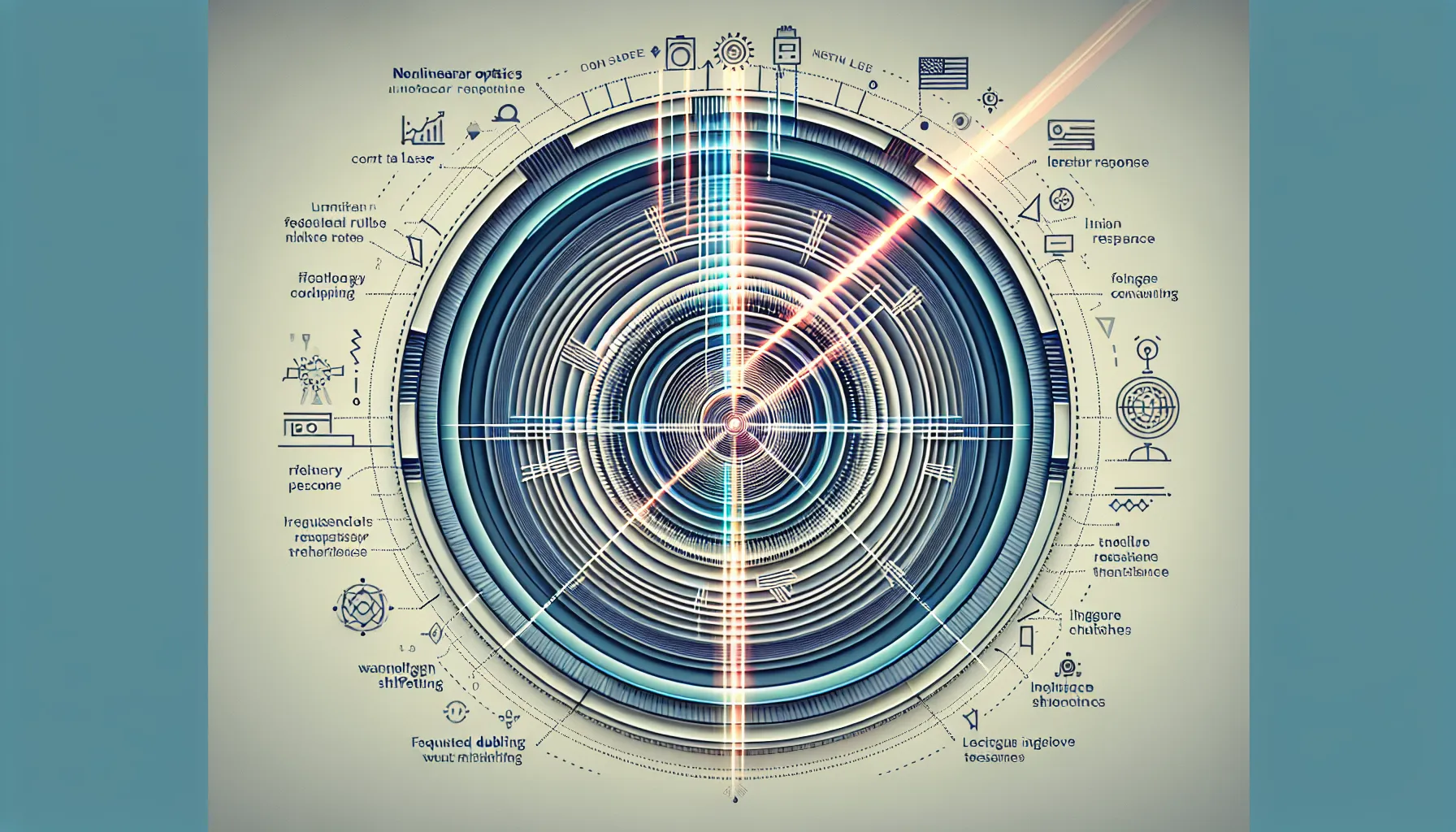
Nonlinear optics describes the fascinating set of physical effects that show up when light, especially laser light, interacts with materials in intense ways. In most everyday situations, materials respond to light in direct proportion to the strength of the field (this is linear optics). But once the light reaches a certain threshold, surprising phenomena emerge: frequencies double, mix, or even shift outside the visible spectrum. This is nonlinear behavior.
We often encounter nonlinear optics in situations where short pulses or very high-intensity lasers are used. When a material displays a nonlinear response, the result could be generation of new colors (wavelengths), controlling the phase of a beam, or modulating amplitude with high fidelity. Nonlinear responses form the backbone of technologies like frequency doublers in green laser pointers, or selective amplification in communication systems. This physics opens the door to advanced manipulation of light, essential for today’s high-speed and high-precision optical equipment.
What makes this field so compelling? Every time we push the limits of intensity, pulse length, or wavelength, new nonlinear effects come into play, allowing us to fine-tune light in ways that linear optics never could.
Basic Properties of Nonlinear Optical Crystals
So what distinguishes a nonlinear optical crystal from any other? At the heart of its power is the ability to support what are known as second- and third-order effects. These refer to how a material’s polarization, how its electrons respond to light, behaves when exposed to a strong electromagnetic field.
Several properties matter the most:
- Transparency Range: These crystals need to remain transparent over a wide range of wavelengths, extending from ultraviolet (as far as 192 nm) well into the infrared (up to 2000 nm), depending on the application.
- Nonlinear Coefficient: This figure tells us how efficiently a crystal will generate new frequencies: larger coefficients lead to stronger effects.
- Phase Matching: To transfer energy efficiently between light beams of different frequencies, the crystal must be cut or oriented just right to achieve ‘phase-matching’, a bit like perfectly tuning a musical instrument.
- Damage Threshold: Nonlinear optical crystals often face very high light intensities, so they must withstand strong beams without degrading or breaking.
Crystals that combine high optical quality with broad bandwidth and stability become mainstays in research and industry alike.
Major Types of Nonlinear Optical Crystals
Let’s look at a few important categories you’ll find in leading-edge labs and commercial laser setups:
- Beta Barium Borate (BBO): Praised for its wide transparency and broad phase-matching, BBO is a workhorse for frequency conversion, such as doubling or tripling laser lines, think green and UV laser sources.
- Potassium Titanyl Phosphate (KTP): Known for excellent nonlinear efficiency and high optical damage threshold, KTP works well in green laser pointers and pulse selection for mode-locked lasers.
- Lithium Niobate (LiNbO₃): Highly versatile, lithium niobate is widely used in electro-optic modulators, wavelength conversion, and optical telecom systems.
- Potassium Dihydrogen Phosphate (KDP): With superior UV transparency, KDP underpins applications like disk mastering and laser amplitude stabilization.
- Others: Newer materials, like LBO (Lithium Triborate) and periodically poled crystals, allow flexibility in both wavelength and conversion efficiency.
Each type stands out due to its unique combination of transparency, efficiency, and resilience against intense light. Knowing which to use depends on our target wavelength, required bandwidth, and the specific nonlinear process, whether it’s generating pulses, stabilizing amplitude, or deflecting beams.
How Nonlinear Optical Crystals Work
The secret to these powerful effects lies in the atomic structure of the crystal. When a strong light wave travels through the lattice, it pushes charges (mostly electrons) in ways that aren’t strictly proportional to the incoming field. Instead, we see mixing or multiplication of frequencies.
Take second-harmonic generation, for example. If a laser of 1064 nm (infrared) is sent into the right crystal, the output can be 532 nm (green), achieved by forcing two photons to combine and release their energy at a new, higher frequency.
Another common effect is sum-frequency or difference-frequency generation, where two input beams enter the crystal and a third frequency comes out, the sum or difference between the original two. This allows us to create deeply tunable sources for spectroscopy, communications, and biomedical imaging.
Phase matching is crucial: the atomic spacing and crystal orientation must let all the interacting waves keep pace with one another. If not, the effect fizzles out. So, the ability to fabricate and handle crystals to such exacting standards is part of what makes this field so exciting for scientists and engineers.
Even minor tweaks to temperature or angle can tune these effects, making nonlinear crystals both a science and a craft.
Key Applications in Science and Technology
Nonlinear optical crystals show up everywhere high-performance optics are needed. Here’s a glimpse at their roles in modern research and industry:
- Pulse Selection for Mode-Locked Lasers: Crystals enable extraction of individual pulses from fast trains, letting scientists study ultrafast events and develop new test equipment.
- Optical Tweezers: Nonlinear materials improve precision in trapping and moving microscopic particles, vital for cell biology and nanotechnology.
- Laser Amplitude Stabilization: By controlling intensity with unmatched responsiveness, optical modulators built from these crystals provide quiet, steady beams for sensitive experiments.
- Disc Mastering: High-purity crystals used in mastering systems generate controlled pulses to inscribe ultra-fine detail on media, essential in data storage industries.
- Optical Isolators: These prevent feedback in laser systems, preserving the integrity of signals even in challenging environments.
We see demand from research institutes, universities, the military, and manufacturing. Nonlinear crystals fuel innovation in communications, imaging, quantum computing, and beyond. Their properties push boundaries in both commercial devices and custom scientific setups.
Challenges and Future Trends in Nonlinear Optical Crystals
Even though their value, working with nonlinear optical crystals brings real challenges. Precision growth and processing is crucial, crystal defects or contamination quickly degrade performance. Reliable phase matching across wider bandwidths is another key hurdle. As device requirements grow, so do expectations for higher efficiency and environmental stability under intense use.
Looking forward, new materials such as engineered composites and periodically-poled structures promise advances. Researchers are also exploring crystals with higher resistance to damage, greater thermal stability, and expanded wavelength coverage. Miniaturization is on the horizon as well: compact crystals can enable portable, chip-scale photonic systems.
The trend is clear: increased control over frequency, amplitude, and polarization is leading to breakthroughs in communications, sensing, and data storage. As we continue to refine both material science and application engineering, nonlinear optical crystals will remain at the forefront of optical technology.
Conclusion
Nonlinear optical crystals have revolutionized how we generate and manipulate light. Whether enabling microsecond-precise pulse picking, stabilizing beams for sensitive measurements, or powering high-capacity data storage, their impact is far-reaching. As demand grows for greater speed, control, and reliability in optics, we’re adapting fast, introducing new materials and refining existing ones. For anyone passionate about light, nonlinear crystals are both a familiar workhorse and a frontier for innovation. Where will creative application and new discoveries take us next?
Frequently Asked Questions About Nonlinear Optical Crystals
What is a nonlinear optical crystal and how does it work?
A nonlinear optical crystal is a special material that can change the properties of light when exposed to strong laser beams. Unlike regular materials, these crystals can mix, double, or shift light frequencies due to their unique atomic structure, enabling advanced manipulation of light in optical systems.
What are the main applications of nonlinear optical crystals in technology?
Nonlinear optical crystals are essential for frequency conversion in lasers, pulse selection in ultrafast experiments, amplitude stabilization in sensitive optics, optical tweezers for manipulating tiny particles, disc mastering, and isolators to protect laser systems. They are widely used in scientific research, telecommunications, medicine, and manufacturing.
Which properties make a material suitable as a nonlinear optical crystal?
Key properties include a wide transparency range, a high nonlinear coefficient for efficient frequency generation, reliable phase matching for energy transfer, and a high damage threshold to withstand intense light. These characteristics ensure performance and durability in demanding optical applications.
What are some common types of nonlinear optical crystals?
Popular types include Beta Barium Borate (BBO), Potassium Titanyl Phosphate (KTP), Lithium Niobate (LiNbO₃), Potassium Dihydrogen Phosphate (KDP), and Lithium Triborate (LBO). Each offers different advantages in terms of transparency, efficiency, and resistance to high-intensity light.
How do you choose the right nonlinear optical crystal for your application?
Selecting a nonlinear optical crystal depends on factors like the required wavelength range, desired frequency conversion process, bandwidth, and the intensity of the light involved. Matching the crystal’s properties to the specific needs of your experiment or device ensures optimal performance.
What are the future trends in nonlinear optical crystals?
Future trends include the development of engineered and periodically-poled crystals, materials with greater thermal and damage resistance, and miniaturized, chip-scale crystals for portable photonic devices. These innovations aim to improve efficiency, stability, and expand the range of applications.